
I found this fascinating. I wondered what the criers were thinking, what their experiences were like, what brought them to the exhibit in the first place, what they were feeling at that moment and why. I felt similarly curious and in awe in viewing Shrin, a film I found very difficult to watch, but nonetheless thought-provoking. I have always been interested in peoples's emotional responses to art, and how strong they can be. I know several people who get more visibly emotional at watching Finding Nemo than at hearing a death.
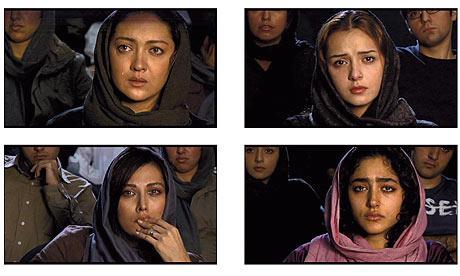
How do films provoke such emotional response? I think that the screen acts as a sort of security blanket, suggesting a distance between the film itself and the viewer, making the viewer then more comfortable and at-home. With fewer defenses, as one may have in a social situation, films can be more affecting and perhaps reach a more unguarded part of the mind and heart. I think it is not what is in the film that makes a person cry, but rather what it reminds them of.
I read that in filming Shirin, the director had not yet picked which movie the actresses would be watching. Their reactions were, therefore, not prompted by what they were viewing, but by the director himself. I wonder how these reactions were inspired, and I'm interested in seeking out a making-of video to learn how the director prompted such visceral, emotional reactions.

I had similar questions about Shirin after reading that the reactions for the film had been staged. Before I watched Shirin, I took it to be a true work of voyeurism – revealing something about our urge to look so intently at the screens put in front of us. However, after reading that I am not sure what to make of it. While still a striking piece, I feel like something is lost for me. Kiarostami choosing his reaction shots as any other director would.
ReplyDeleteFor me, Shirin would have been a more powerful experience if I hadn’t learned about its construction. The film bears the name of the story of Shirin, but the reactions aren’t even to Shirin. The reactions are to some promoting from Kiarostami that we will never know. From what I read, the women were filmed in Kiarostami’s living room and were asked to stare at dots above his camera. As such, the entire filming was in a setting entirely of Kiarostami’s control. Where, you think you’re freely seeing the reactions of these actresses, you learn that everything about it is constructed. Sure, the film is still uncomfortable and still reveals to your own voyeurism, but that voyeurism is extremely constructed.
I wonder how long Kiarostami taped each women. The film itself is 92 minutes, but he surely didn’t prompt and film each of the actresses for that long. As such, he had complete control in what we were viewing. As such, the film reveals to me more about the control of directors in film than my own voyeurism now.
Like Nina, I am interested in finding the making of video, Taste of Shirin to learn more about the film’s construction. I think it would help me figure out how to feel about it after learning about its construction.