Thursday, May 10, 2012

Response to Assvengers

This was just meant to be a response to Nina's post, but I couldn't figure out how to post images in a response: 

I am thankful to both you and Noah for your postings on The Avengers. I had never seen the poster of Johansson butt forward before and find it to be extremely problematic.

Now, my reaction to gender in The Avengers is far less pronounced than Noah’s. This representation was far better than what I was expecting and while yes, the Black Widow was not able to go toe-to-toe with one of the superheroes, I thought she was more than able to hold her own against Hawkeye, who is her rightful match.  I haven’t read the comics, so maybe the Black Widow in them is far different there, but in this representation, I took her as someone very much aware of her strengths and weaknesses. She didn’t torture Loki because as she said earlier in the film, he’s basically a god and you don’t want to get involved in that. Sure, her way of finding out information was particularly feminized, but it worked for her and it played off of Loki’s expectations. Specifically, whenever Black Widow was in scenes like this, I found her playing to male expectations and then using them against the men, more than anything. Why fight and risk him escaping when she doesn’t have to? Moreover, I was just glad that in the film none of the other Avengers ever told the Black Widow to sit anything out because while she is an highly trained assassin and spy, she isn’t exactly super like them. That happens in far too many films and every time I want to bang my head into a wall. Instead, it was the opposite in this film and the Black Widow was actively sought out. Also, the Black Widow had the third most screen  time (33 minutes and 35 seconds, the most screen time being 37 minutes) of any of the six heroes, which I find particularly striking. While more could be done in the future, to make the Black Widow even more active, I thought this was a fine start. Again, I am not saying it was the best representation or anywhere near close to being so, I am just saying that it was far less problematic than I was expecting. I’ll stop my rambling here and move onto my main point. 

While, as I’ve explained above I had a far less severe reaction to the Black Widow than Noah did, I will say that the camera lingered on her behind far too much. I found this to be problematic the first time I watched it and after being made aware of the poster, I noticed it even more the second time I watched the film. The scene with Loki where she uses his expectations to get what she wants, is a striking example of this. As the camera does its shot-reverse-shot between Loki and the Black Widow, the positioning is such that when Loki is in frame, you see the backside of the Black Widow and her butt becomes a focal point of the scene. Thus, I think these posters reveal a larger problem within The Avengers movie, which is that Johansson is taped in a way that makes it easy for the audience to objectify her. In stark contrast to what Nina found in her Facebook feed yesterday, this is what I saw: 


Moreover, one of the main threads on IMDB this week for The Avengers was all about Scarlett Johansson's ass in the movie, when it wasn't asking about the absence of attention to her breasts.

Thus, while I was, overall, fine with the Black Widow character, I think more attention needs to be paid in the future to how such female characters on screen are taped. The emphasis on her behind could not be denied in the film's two and a half hour run. 


Tuesday, May 8, 2012

Assvengers

I saw the most amazing thing posted on Facebook last night-- a redrawing of the Avengers poster where the men are posing as the woman does in the original poster.  The result: lots of butts.  See for yourself:
I found this, first, hilarious, and second, spot-on in its criticism.  I have not seen The Avengers yet, but I am anxiously awaiting having a free chance to check it out.  I greatly enjoy superhero movies and while I am not a Joss Whedon fanatic, I do admire his mission of including more positive female characters in TV and film.  That is one reason I was surprised to see that there would be such a blatantly misogynistic image for the poster touting his biggest film to date.  I figure that the poster was not of his design, but rather the work of advertising or promotions people, but I still wish he would've stepped in and prevented this design from going through.  

The depiction is disappointing for several reasons.  First, Scarlett Johannsson's Black Widow is the smallest figure on the poster.  Second, she is, obviously, standing inexplicably with her butt to the camera, while her fellow Avengers stare almost front on, showing their strength directly to the viewer.  Her body position is so twisted it is comical.  I'm glad that someone noticed this and made the second version to call attention to it.

I look forward to seeing The Avengers and seeing how her character is in the film.  Hopefully Joss Whedon stays on his track and wasn't swayed by the studio to play her only as a sex symbol, as the poster clearly does.

Race in The Hunger Games

I was one of the millions of people to pay money to see The Hunger Games in theaters on opening weekend.  I have read only the first book, and while the writing was a bit dumb, I thought the story was fantastic.  The author Suzanne Collins built a complicated, thought-provoking world and I admired its having a strong female protagonist.  I also admired how despite their being a love triangle in the story, it was by no means the core of the book, and by no means defined the protagonist, Katniss.

I enjoyed the film adaptation.  I thought it was loyal to the book and I think Jennifer Lawrence did an excellent job in the lead role.  In fact, the whole cast was fantastic.  I was alarmed, then, a few days later when I saw a piece on Jezebel called "Racist Hunger Games Fans Are Very Disappointed."  This piece pulled tweets from, well, disappointed racist Hunger Games fans.  Why were they disappointed?  Because the character of Rue was played by an African-American girl.  Tweets read, "why does rue have to be black not gonna lie kinda ruined the movie," "EWWW rue is black?? i'm not watching," and "Kk call me racist but when I found out rue was black her death wasn't as sad."  I've seen similar tweet collections before, calling out the idiocy of Internet-using Americans, but I foudn this instance particularly striking and disgusting.  Soem tweeters said that Rue, the little angel she is, should have been played by a blonde girl, because of course "blonde" and "white" mean "good."  Several people mentioned that this depiction ruins how the book describes Rue, but in fact, the book makes Rue's race quite clear.  She is described as being a girl with "dark brown skin and eyes."  Plain and simple.

This incident got be wondering how we see race on film in contrast with other media.  Clearly, in the book, people saw race as something that could be overlooked or ignored, a sort of racial cleansing in the mind.  Do some people just choose not to imagine black people?  On film, that sort of mind-trickery doesn't work--the race is there, present, visible.  It can't be ignored or passed over, it can't be reimagined.

Readers of the Hunger Games fell in love with the character of Rue, and it was incredible how quickly they turned on her when they saw her race.  It reminds me of how some people can be disowned by their families or rejected by friends after coming out as being homosexual.  Their character and personality has been demonstrated for years, but it's some revelation that, finally visible and open, that is enough to "ruin" them.

I hope that these people felt remorse and thought about their words and attitudes critically when they received, I imagine, countless tweets about their disgusting behavior, and I hope that filmmakers will see this as a crucial reason that more people of color need to be visible on screen.

Reflections on Shirin

During our discussion of Shirin, I mentioned Marina Abramovic's exhibit "The Artist Is Present," in which she sat for hours a day without moving at the NY MoMA.  Museums guests could sit across from her for hours at a time, and many did, also motionless.  A photographer was on hand to photograph anyone who sat across from Marina and post the photos online.  I spent a lot of time perusing this album, looking at the range of people (there was no racial, age, or gender pattern to be found) that sat across from the artist.  Even stranger to observe was the amount of time people would spend staring at her.  And, even stranger to observe than that, was noting the number of people who were in tears in their photos.  Many, many people were in tears.  So many that someone started a tumblr called "Marina Abramovic Made Me Cry."

 I found this fascinating.  I wondered what the criers were thinking, what their experiences were like, what brought them to the exhibit in the first place, what they were feeling at that moment and why.  I felt similarly curious and in awe in viewing Shrin, a film I found very difficult to watch, but nonetheless thought-provoking.  I have always been interested in peoples's emotional responses to art, and how strong they can be.  I know several people who get more visibly emotional at watching Finding Nemo than at hearing a death.


How do films provoke such emotional response?  I think that the screen acts as a sort of security blanket, suggesting a distance between the film itself and the viewer, making the viewer then more comfortable and at-home.  With fewer defenses, as one may have in a social situation, films can be more affecting and perhaps reach a more unguarded part of the mind and heart.  I think it is not what is in the film that makes a person cry, but rather what it reminds them of.

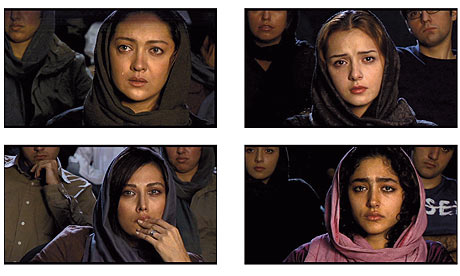
I read that in filming Shirin, the director had not yet picked which movie the actresses would be watching.  Their reactions were, therefore, not prompted by what they were viewing, but by the director himself.  I wonder how these reactions were inspired, and I'm interested in seeking out a making-of video to learn how the director prompted such visceral, emotional reactions.

Witches as Uncanny

For my final paper, I chose to write about representations of witches in film.  During my research, I found that many representations were more uncanny than outright monstrous.  Witches were never totally inhuman creatures--they were slightly tweaked women, akin to Medusa with her snake-hair.


In The Witches, the adaptation of the Roald Dahl book, the titular witches roam among non-magic humans inconspicuously except for one tiny note: they have bright purple eyes.  In an early scene, the protagonist, a young boy, is up in a tree, and a woman tries to lure him down with candy.  She almost succeeds--she looks proper, clean, and beautiful--until the boy notices her purple eyes, which he has been taught to look out for.  The eyes are so bright and radiant that, despite being a pleasant color, create an aura of uncanniness around an otherwise ordinary, pretty woman.


Without their "pretty lady" disguises, the witches are terrifying creatures, with exaggeratedly ugly features: huge hooked noses, wrinkles, hunched backs, wisps of gray hair on otherwise bald heads...the list goes on.  These witches are disgusting, and the way the ugliness draws upon actual human features makes it all the more effective.

I found, though, that I almost thought the witches in beautiful disguises to be more frightening, for their creepy uncanniness, all focused into their bright purple eyes.  These witches were the sneakiest, the most likely to convince you that they were good, and the most able to blend into society.  The ugly, witches, with their true visages, were by all means scary, but almost too monstrous to seem realistic, despite drawing on the human face as a model.

Such uncanniness reminds me of movies like Chucky, which poses a toy as the horrific villain partly through changes to its image, and any movie with vampires, in which just pale skin and pointy teeth are uncanny and unsettling enough to spark fear.


Monday, May 7, 2012

Removed


This film did not disturb me as much as I thought it would. I think generally I was relieved that the female bodies were removed but I had mixed feeling of them. Because it was taken from a pornographic film, obviously I did not enjoy nudity. I would not enjoy how my body, resembling theirs, is used in this context for male sexual gratification. I am not implying that females are not spectators of pornographic imagery but they are generally made with male pleasure in mind. Looking back at Mulvey’s piece we read in class, pornography are those films who more explicitly make use of the female form and exploit for object of the male gaze.

It could be argued of course that these women have more agencies because they are getting paid to perform sexual acts in from of a camera, but it is the same with conventional Hollywood films as well. The reason “Removed” was refreshing was because of the lack of nudity of course, and because I saw it within feminist contexts. The removal of the female body draws even more attention to it in spite of it not being present. Her power in drawing focus is greater compared to the lesser roles the male characters play in the films.
However, in spite of this point of view, I see pornographic films very negatively in portraying the female body. It completely surrounds the notion that the female body is an exhibition of sexuality, when the male figure can be eroticized and emphasized just as well. 

Loretta after thoughts


I commented on one of the responses for another classmate on the Vanishing Lady and it made me think of various things such as female anonymity. This film, Loretta, is an experimental film that as I understood had frames with a female figure in it. I know we discussed in class how the female figure seemed to be confined to the frame and it looked like she was trying to escape but couldn’t.

This reminds me of how the female form is constructed in film. In classical Hollywood cinema the female form is eroticized to appeal to the male gaze, the dominant gaze. She is confined to be eroticized in order to be noticed, or the center of attention, but within these parameters she is damned to stay within them. Within them she is nothing more than just the object of male desire, objectified and sexualized, but never really given a chance to become more than just a visual pleasure object. And not to mention that apart from all of this, she is expendable. Many starlets will take her place once she becomes decrepit and her physique no longer resembles the expectation. Creams, make-up, clothes are all used for the purpose to highlight and bring attention to her physical attributes to remain seen even though she is unseen and misunderstood. This is however, the only option the female form has in a subjugated rank in this society unless she becomes “masculinized” and “active” and changes her place in society.

The only way to not be eroticized is to physically not resemble the female form. This has a price to pay however. The small attention the female form gathers is from the male gaze that subjects it to objectification. The transformation into something that resembles more the male form receives antagonisation and aggression because the male gaze sees it as a threat to its dominance over the female form.

The film may be an example of this paradoxically of course, in that the anonymity of the female form contributes to its objectification and yet the rapid movement between frames makes this form disappear and appear, making it difficult to tell whether it is a female form or not. The rapid movement of the frame makes it difficult to eroticize the female form precisely because it cannot be clearly seen and distinguished as a female form.

Of the films that we watched at the Walker, I really enjoyed this one and Removed because it opens up a significant amount of room for discussion and interpretation.